How Often Should You Flush a Water Heater?
Learn the right flushing schedule for your water heater based on water hardness, tank age, and household size. Most homes need it once or twice a year.

April 1, 2026
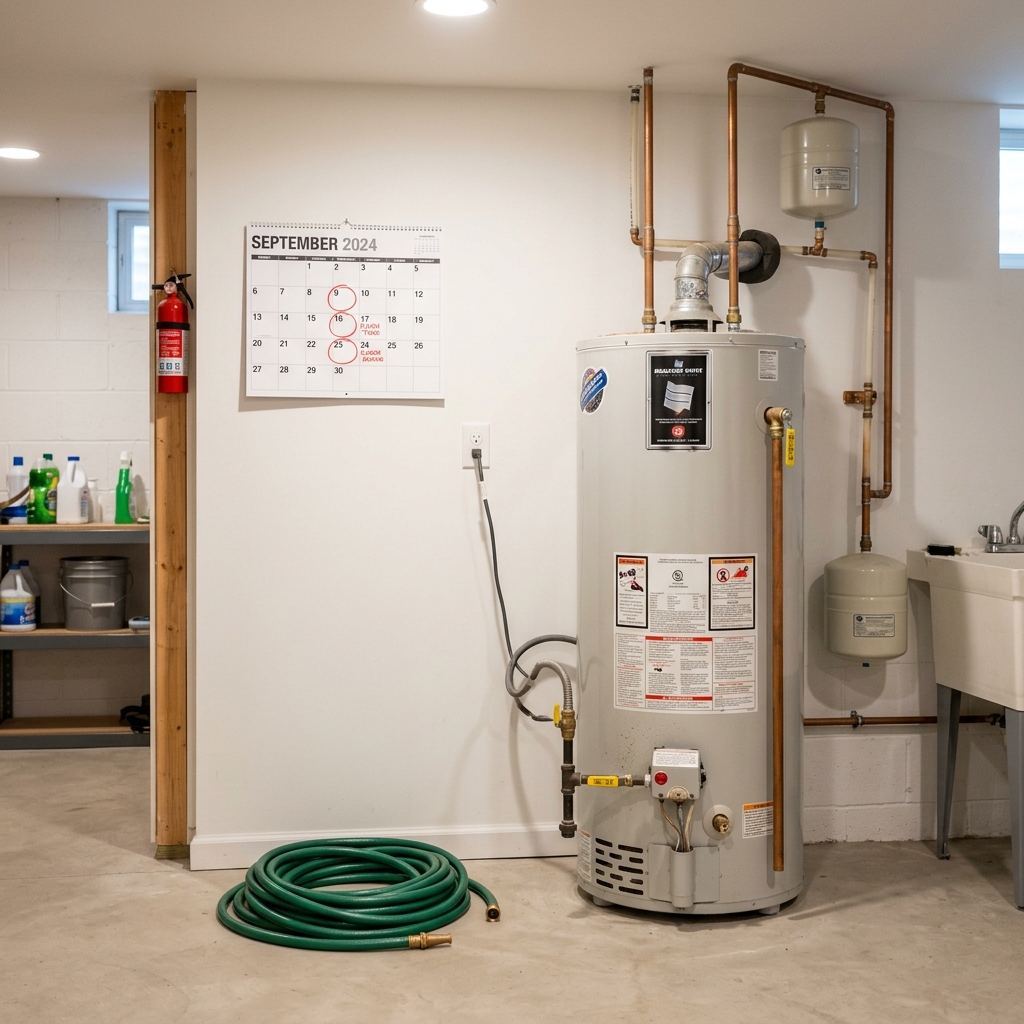
Unique angle here: grains-per-gallon and a bucket-grit test before the calendar reminder. The compact hose-and-valve sequence is how to flush your water heater. The complete sediment-and-vinegar version is how to flush a water heater (complete guide).
Desk note: This page does not invent a “5 to 10 percent efficiency” drop at month 18. Sediment steals volume and makes noise. Energy.gov and manufacturer manuals tell you to flush. They do not publish a desk-measured percent for every tank. Intervals below are a hardness-and-age framework, not a warranty.
The one-year answer is fine for a lot of houses. It is wrong for a 12 GPG well with no softener, and it is conservative for a softened tank that still runs clear at month 14. Get the grit and the GPG first. Then set the reminder.
Before You Set a Calendar
Do this in order. Picking “every October” without a bucket sample is how people skip a seized valve until the handle snaps.
- Get hardness in GPG (or ppm). Utility water-quality report, or a $10 strip kit. Soft is about 0–3 GPG. Hard starts around 7 GPG. Very hard is 10+. Hardness chemistry: how hard water destroys a water heater.
- Bucket-test the drain. Open the valve into a clear jug for a quart, then close it. Sandy or cloudy means you are due now, whatever the calendar says. A dribble that will not move is a clog or a seized valve — water heater not draining — not a longer hose.
- Decode tank age from the data plate. Serial formats live on how long water heaters last. Past about eight years, shorten the interval even if the water is moderate.
- Note household throughput. Five people cycling a 50-gallon tank daily deposit more mineral than one person. People are a multiplier on hardness, not a substitute for GPG.
- Then hose. A Flexzilla 5/8-inch by 50-foot garden hose is the hose this site already points at: garden-hose thread, stays flexible in a closet. Do not dump the first hot minutes where a person or pet can step.
Listing check (schedule hose, not a descaler jug): confirm 5/8-inch garden-hose thread sold for outdoor or utility use — drinking-water RV hoses and tankless descaler jugs share the same “flush” browse.
Next-flush date from hardness, age, and household size: flush schedule calculator. Setpoint while you keep the tank: water heater thermostat adjustment.
The Short Answer
| Situation | Starting interval |
|---|---|
| Hard water (above 7 GPG), no softener | Every 6 months |
| Moderate water (3–7 GPG), no softener | Every 12 months |
| Soft water or a working whole-house softener | Every 12–18 months |
| Heavy usage (5+ people) | Shorten the hardness row (often 6–9 months) |
| Light usage (1–2 people) | You can sit at the long end of the hardness row |
| Tank older than about 8 years | Every 6 months, then believe the bucket |
| Tankless water heater | Descale every 12–18 months (different kit) |
If the bucket is already sandy, flush this weekend. The table is a starting interval, not permission to wait.
Why the Interval Matters
Sediment is gradual. The useful question is how fast your water adds to the pile.
Early months: A fine dusting. You will not hear it.
Hard-water first year: The layer gets thick enough to steal volume and to pop. That is a maintenance job, not a published efficiency percent.
Years of neglect: The pile can bake into a crust. Popping gets constant. The floor overheats. Hot-water volume drops because grit is sitting where water used to be. A late flush may not lift a mineral-concrete floor — 7 signs a water heater is failing.
Catching it while the grit is still loose is why annual is the baseline. Hard water shortens that. A working softener lengthens it.
Water Hardness: The Biggest Variable
| Hardness | GPG | PPM | Starting interval |
|---|---|---|---|
| Soft | 0–3 | 0–60 | Yearly, or 18 months if the bucket stays clear |
| Moderate | 3–7 | 61–120 | Every 12 months |
| Hard | 7–10 | 121–180 | Every 6–9 months |
| Very hard | 10+ | 180+ | Every 6 months, then believe the bucket |
Southwest, Great Plains, and parts of Florida and Texas often sit in the hard / very-hard rows. Pacific Northwest and much of the Northeast often sit softer. There are exceptions on both coasts. Read the report for your address.
A working whole-house softener removes most calcium and magnesium before the heater. You can usually use the 12–18 month row. A bypassed or exhausted softener does not count.
Household Size and Tank Age
More people means more gallons through the tank and more mineral dropped. Use the hardness row, then shorten it for a full house.
Older tanks are less forgiving:
- The anode is more likely spent. Rust particles join the mineral pile — when to replace your anode rod.
- The glass lining has more cracks. Sediment against bare steel is worse than sediment against intact lining.
Past about eight years, start at six months and let the bucket confirm. An hour twice a year is cheaper than an emergency replacement. Lifespan split: how long water heaters last.
How to Tell You Are Overdue
- Popping or rumbling on a heat cycle — water heater popping noise
- Discolored hot water (cold side clear)
- Showers going cold sooner than they used to
- A bill that crept up with no other change (a clue, not a percent)
- Grit in the first quart from the drain
Deeper symptom list: signs your water heater needs flushing.
Flushing vs. Draining
Draining empties the tank for a repair, a move, or a replacement. Full walkthrough: how to drain a hot water heater.
Flushing runs fresh water through an open drain so grit leaves. You do not always empty the tank. Step-by-step: how to flush a water heater.
Routine sediment removal is a flush. A full drain is for other work on the heater.
Setting a Schedule That Sticks
Forgetting is the usual failure, not technique.
- Tie it to another annual job (furnace filter, smoke-alarm batteries)
- Set a phone reminder
- Use the flush schedule calculator for a next-flush date and a calendar file
- Inspect the anode while you are already at the tank
- Write the date on tape on the jacket — annual maintenance checklist
A warmer tank scales faster. If the dial is still at factory 140°F, measure the tap before the next flush: water heater thermostat adjustment. A blanket does not replace a flush: how to insulate a water heater.
Tankless Is a Different Job
Tankless units do not store a pile of grit. They scale the heat exchanger. Descale with vinegar or a citric kit and a pump every 12–18 months (12 in hard water). Kits: best tankless flush kits. Whether tankless is even the right machine: tankless water heater pros and cons.
Skip the Calendar Flush
- Seized or cracked drain valve — replace the valve on a controlled drain, do not snap the handle
- Water from the steel shell or under the foam — that is replacement, not a schedule
- An electric tank you cannot isolate at the breaker
- No drain path and no way to route a hose
- Gas odor or a T&P that dumps steadily
- You have a tankless unit and you are about to hook a garden hose to a service port without isolation valves — wrong procedure
Related Guides
- How to Flush Your Water Heater: Step-by-Step Guide
- How to Flush a Water Heater (Complete Guide)
- How to Drain a Hot Water Heater
- How to Insulate a Water Heater
- How Long Do Water Heaters Last?
- Water Heater Thermostat Adjustment
- Tankless Water Heater Pros and Cons
- Water Heater Temperature Settings
- Gas vs. Electric Maintenance
- Flush Schedule Calculator
- How to Flush Hub
Sources
- U.S. Department of Energy, Maintain Your Water Heater, flush-as-maintenance language
- Water Quality Association, Hard Water, hardness classifications
- USGS, Water Hardness, regional hardness context
Editorial Team
Nobody should pay a plumber $300 to turn a drain valve. Our guides are built from manufacturer documentation, plumbing code references, and the documented experience of homeowners and plumbers.