Tankless Water Heater Pros and Cons: An Honest Assessment
Tankless water heaters save energy but cost more upfront. Here is what manufacturers do not tell you.

May 26, 2026
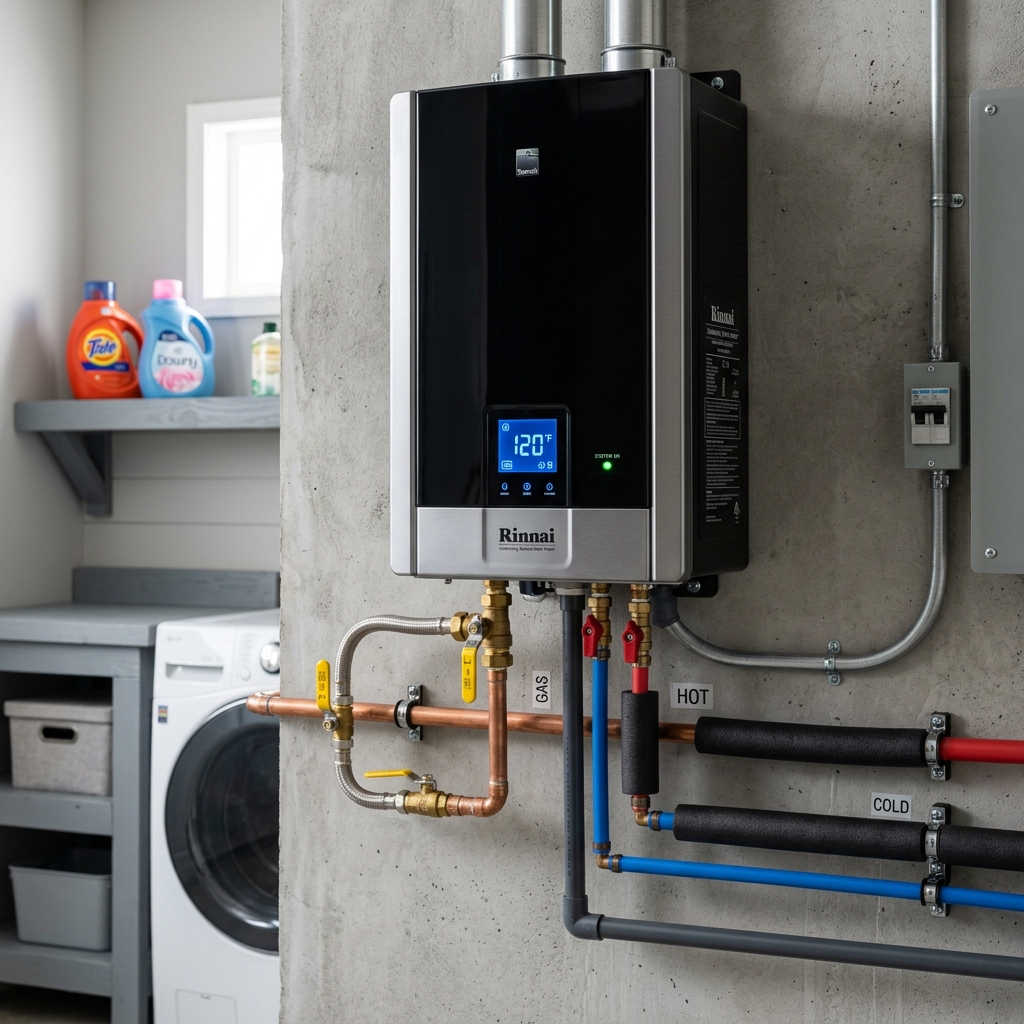
Unique angle here: the honest cons that kill the sale. The side-by-side chooser is Tank vs. Tankless Water Heaters.
Desk note: Cost and lifespan bands below are research ranges from typical listings and published DOE tankless-efficiency language, not a payback calculator from this desk. This page does not invent a 24–34 percent or a $200-a-year guarantee. “Endless hot water” is a flow-rate claim at a stated temperature rise. It is not a promise that two rain showers will run in a 40°F groundwater climate on a mid-size unit.
Household-fit is simultaneous-fixture GPM plus how many years you will stay. A three-year stay rarely “pays back” a gas-line upgrade. Fuel after the machine type is electric vs. gas.
Before You Shop Tankless
Do this in order. Converting “we have a 50” into a tankless SKU by gallons is the usual miss.
- Count simultaneous fixtures, not people. Two showers plus a dishwasher is a GPM problem. Write the fixtures and their labeled GPM.
- Measure incoming cold-water temperature in winter. A Taylor instant-read waterproof thermometer in a glass at the nearest cold tap, after a 30-second run, is enough. Heating 40°F groundwater to 120°F is an 80°F rise. The same unit publishes a higher GPM on a 50°F rise.
- Read the current rating plate. Fuel, vent, voltage, and gas-line size tell you whether this is a hang-on-the-wall or a gas-line-and-vent ticket.
- Decide how many years you will stay. Upfront install research ranges are the large number. Energy.gov savings language is the small annual number.
- Then open a listing. Indoor vs outdoor and natural-gas vs propane suffixes sit on the same parent page as the headline GPM.
Listing check (tankless GPM vs marketing GPM): confirm gallons-per-minute at a stated temperature rise plus indoor/outdoor and NG/LP suffixes — headline GPM and RV / point-of-use tankless units share the same brand search.
Current SKUs: best tankless water heaters. Descale gear: best tankless flush kits. How long either machine lasts: how long water heaters last.
The Real Pros
1. Endless Hot Water — Inside a GPM Cap
A tankless heater heats water as it flows through a heat exchanger. Stay inside the unit’s flow rate at your winter rise and you will not empty a stored tank. That is the headline, and it is real.
It is not “unlimited fixtures.” Two 2.5 GPM showers plus a dishwasher is a math problem. Size that hour before you buy the wall unit.
2. Lower Standby Loss
A tank keeps 40 to 80 gallons hot all day. That standby loss is why Energy.gov publishes a tankless-efficiency advantage, and why the advantage is larger at low daily use and smaller when the house already runs a lot of hot water. Treat those published bands as guidance, not a $100–$200 check.
If you are keeping a tank instead, a blanket and a measured setpoint are the cheap standby levers.
3. Longer Published Window
Research ranges for tankless often land around 15–20 years; tanks around 8–12. Over two decades you might buy one tankless or two tanks. That only matters if you stay in the house and you descale. Modular parts (exchanger, board) can be serviced. A tank with a hole in the steel cannot.
4. Floor Space
A wall unit is roughly suitcase-sized. A 50-gallon tank takes floor and headroom. Tight utility rooms are a real reason to go tankless. It is not a reason to ignore gas-line and vent work.
5. No 50-Gallon Dump
No storage tank means no 40–80 gallons waiting to empty through a rust hole. Fittings can still leak. The flood volume is smaller. A pan sensor on a tank you are keeping is cheaper than a conversion: best water leak detectors.
The Real Cons
1. High Upfront Cost
This is the dealbreaker. A quality gas tankless unit such as the Rinnai RU199iN is a research-range $1,000–$2,500 for the unit. Install often adds $1,500–$3,000 when the gas line, vent, or a condensate drain is new.
Total installed research ranges: about $2,500–$5,000 for gas, $1,500–$3,000 for electric. A tank swap is often $800–$2,000 installed. Those are filters, not quotes.
Confirm the listing is the indoor/outdoor and NG/LP suffix you copied from the plate. The same parent page mixes 11 GPM condensing units and point-of-use electrics.
2. The Cold Water Sandwich
Open a hot tap, stop, open it again: a slug of hot (pipe residual), then cold (the gap before the exchanger relights), then hot. That is the system, not a defect. A small buffer tank or a recirculation loop hides it and adds cost.
3. Flow Rate Limitations
A tank delivers stored volume at whatever GPM the pipes will give. A tankless unit has a maximum GPM at a stated rise. Exceed it and the output goes lukewarm.
A typical gas tankless might publish 8–10 GPM at a mild rise (around 60°F incoming). At 40°F incoming the same unit may only hold 5–6 GPM at 120°F. Two showers plus a dishwasher can be fine in Houston and short in Minneapolis in January.
4. Installation Complexity
Tank-for-tank is a swap. Tank-to-tankless often includes:
- Upsizing the gas line (1/2-inch to 3/4-inch is common)
- New category III / condensing vent (the old B-vent usually does not reuse)
- A condensate drain on condensing models
- A dedicated electrical circuit for the board and fan
- Sometimes a move to an exterior wall
Each line is labor and materials. That is why install is such a large share of the ticket.
5. Maintenance Is Not Optional
A neglected tank can limp for years. A neglected tankless exchanger clogs. Hard-water houses that skip the annual descale get error codes and, later, a $400–$800 exchanger conversation.
Descale is about an hour with a flush kit. Interval: how often to flush a water heater (tankless row). It is a different hose-and-pump job than a tank drain.
6. Needs Electricity
Gas tankless still needs power for the board, igniter, and fan. A standing-pilot tank can still heat in an outage. If outages are common, budget a battery or generator, or keep a pilot tank.
The Real Math: Stay-in-House Years, Not a Guarantee
| Item | Tank (research) | Tankless (research) |
|---|---|---|
| Installed cost | ~$1,500 | ~$4,000 |
| Annual energy | Depends on rates and use | Energy.gov: usually lower standby |
| Annual maintenance | Flush; parts as needed | Descale; isolation valves |
| Published window | ~8–12 years | ~15–20 years |
A table that subtracts $150 a year until the install “pays back” is a story problem, not your bill. Tankless is more likely to win the household-fit test when:
- You will stay 10–15+ years (you avoid buying a second tank)
- Peak simultaneous GPM fits the winter rise
- Gas or electric rates make standby loss expensive
- You are already opening walls (new build or a gut remodel)
- A tank dump in that room would be a flood you cannot live with
It is less likely to win when the stay is short, the gas line is 1/2-inch, or you need hot water during outages.
Who Should Go Tankless
- Peak-hour GPM is the problem, and you sized the winter rise
- You plan to stay long enough that a second tank would have been in the picture
- Floor space is the constraint
- The house is already open for vent and gas work
- You will actually descale
Who Should Stick with a Tank
- Upfront cash is the constraint
- You are selling within a few years
- The existing tank infrastructure is a clean same-fuel swap
- Outages are common and you want a standing-pilot tank
- Winter incoming temperature makes the published GPM a brochure number
For the chooser table, use tank vs. tankless. A tank you are keeping still needs a flush schedule and a measured setpoint.
Choosing the Right Tankless Unit
Gas (whole-house):
- Condensing models publish higher thermal efficiency; they also need a condensate path
- Size on peak simultaneous GPM at your winter rise, not the jacket’s best-case GPM
- The Rinnai RU199iN is the high-GPM gas listing this page already uses — confirm NG vs LP and indoor vs outdoor
- Current set: best tankless water heaters
Electric (point-of-use or a panel that can take it):
- Better as a single-bath or a distant-fixture booster than as a silent whole-house swap
- Whole-house electrics can demand a large panel (often discussed in the 100–150 amp conversation)
- Lower plumbing drama, harder electrical drama
Skip the Tankless Listing
- You need hot water this week and the gas line or vent is not sized
- You cannot isolate a leak in a finished living space during a conversion
- You are trying to “solve” a well or hardness problem by switching machines — that is how hard water destroys a water heater
- The current tank is leaking at the steel shell — replace the machine you can actually hang, then choose fuel: how long water heaters last
Related Guides
- Tank vs. Tankless Water Heaters
- Best Tankless Water Heaters
- Best Tankless Water Heater Flush Kits
- How Long Do Water Heaters Last?
- How Often Should You Flush a Water Heater?
- How to Insulate a Water Heater
- Water Heater Thermostat Adjustment
- How to Flush a Water Heater
- Electric vs. Gas Water Heaters
- Flush Schedule Calculator
- Water Heater Maintenance Tools
Sources
- U.S. Department of Energy, Tankless Water Heaters, efficiency language and sizing
- Energy Star, Water Heater Specifications, qualified product lists
- Manufacturer rating plates and install manuals for GPM-at-rise, vent, and gas-line notes
Editorial Team
Nobody should pay a plumber $300 to turn a drain valve. Our guides are built from manufacturer documentation, plumbing code references, and the documented experience of homeowners and plumbers.