How to Insulate a Water Heater to Save Energy
A water heater blanket can cut standby heat loss on older tanks. Here is how to install one safely in under an hour.

May 26, 2026
Safety Disclaimer
Water heater maintenance involves working with pressurized systems, scalding hot water, and potentially hazardous electrical or gas connections. Always shut off power (electric heaters) or gas supply (gas heaters) and allow water to cool to a safe temperature before beginning any maintenance. Wear appropriate safety equipment including gloves and eye protection. If you're uncomfortable with any step, contact a licensed plumber.
Unique angle here: the touch-test and gas-clearance check before the blanket SKU. Setpoint is a different lever: water heater thermostat adjustment. How long the tank is worth wrapping is how long water heaters last.
Desk note: Standby-loss language below follows Energy.gov / Energy Saver water-heater insulation guidance. This desk did not run a calorimeter on your garage tank. Older, warm-to-the-touch tanks in unheated rooms are the usual win. A cool 2015+ jacket in a conditioned closet is a small leftover, not a 25–45 percent energy story.
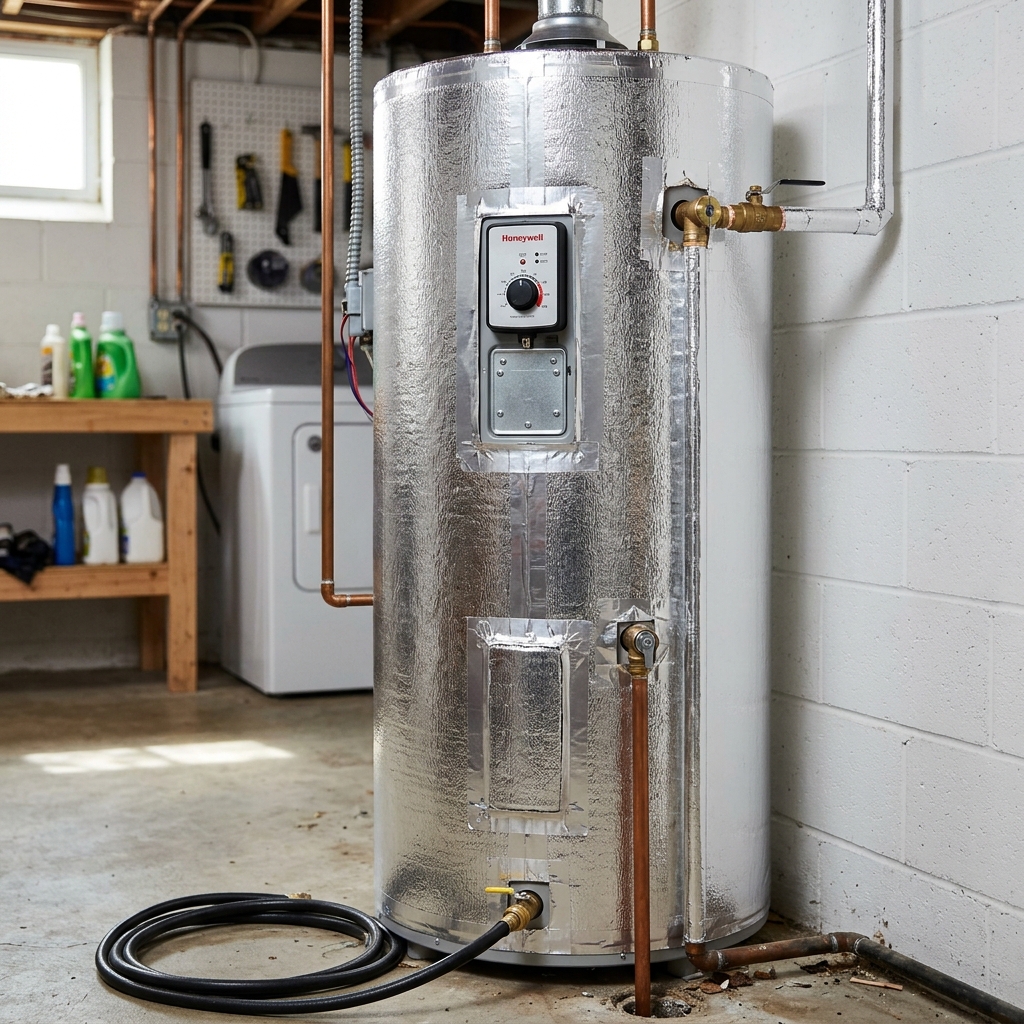
A blanket wraps the tank so heat stays in the water instead of warming a garage nobody is trying to heat. It is a cheap wrap, not a new heater and not a substitute for a working anode or a flush.
Before You Buy a Blanket
Do this in order. Buying the kit first is how people tape foil over a draft hood or wrap a heat-pump tank that needs room air.
- Touch the shell. Place a hand on the side of the tank (not the flue, not the T&P). Warm means heat is leaving. Cool or room-temperature usually means the factory foam is already doing the job.
- Read the energy label and the rating plate. Copy fuel, gallons, and any printed R-value. Pre-2005 tanks are often R-6 to R-8. Many 2015+ tanks are R-12 to R-16. Energy.gov still talks about adding insulation when factory foam is thin; it does not publish a desk-measured percent for every jacket.
- Confirm the fuel path. Gas: flue, draft hood, combustion-air opening, and gas valve must stay uncovered. Electric: access panels and the junction box must stay reachable. Heat-pump / hybrid tanks are a skip — they pull heat from room air.
- Measure height and circumference. Most kits are a one-size sheet you trim. A 75-gallon or a squat 50 can need a different cut than a tall 40.
- Then open a listing. A Frost King water heater insulation blanket is the tank wrap this site already points at: foil or vinyl face, sold for tanks up to about 60 gallons, typically cited as about R-10. Pipe sleeves are a separate SKU. Foam pipe sleeves in 3/4-inch are the usual residential hot-outlet size.
Listing check (tank blanket vs pipe wrap): confirm a water-heater tank blanket (foil or vinyl face, a stated tank-gallon range, R-6 to R-10) — attic batts, pipe-wrap rolls, and heat-tape cables share the same “heater insulation” search.
Flush interval if the tank already pops: how often should you flush a water heater. A tankless unit has no jacket to wrap — that is tankless pros and cons.
Does Your Water Heater Need Insulation?
Not every tank benefits equally.
The Touch Test
If the outer shell feels warm, a blanket can cut standby loss. If it feels cool, the leftover is small. Trust the hand, not a marketing “up to 45 percent.”
Check the R-Value
| Built-in R-Value | Blanket Benefit |
|---|---|
| R-6 to R-8 (older units, pre-2005) | High — usual candidate |
| R-8 to R-12 (2005-2015 units) | Moderate — useful in a cold garage |
| R-12 to R-16 (2015+ units) | Low — optional |
| R-16+ (some premium models) | Minimal — usually skip |
Energy.gov discusses adding insulation when factory foam is thin. Almost no residential tank ships at the high R numbers used for whole-house envelopes. That is why older tanks still show up on this page. It is not a promise that every 2020 tank needs a wrap.
Location Matters
A tank in an unheated garage loses more heat than one in a conditioned utility room. The wrap is most useful when:
- The heater sits in an unheated garage, basement, or crawl space
- The room regularly drops below about 60°F
- Air moves across the tank (a drafty garage door)
What You Will Need
| Item | Purpose | Research range |
|---|---|---|
| Insulation blanket kit (R-6.7 to R-10) | Wraps the tank | $20–$35 |
| Utility knife or scissors | Trims openings | Already owned |
| Measuring tape | Height and circumference | Already owned |
| Foil tape or the kit straps | Holds the seam | $5–$8 |
| Marker | Marks cutouts | Already owned |
| Pipe insulation sleeves | First 3–5 feet of pipe | $3–$10 |
Treat those dollar bands as street-price research, not a quote.
Safety Rules Before You Start
Covering the wrong opening is the failure mode. Follow the fuel you copied.
For gas water heaters:
- Never cover the top of the tank. The flue and draft hood stay fully exposed.
- Do not cover the gas control valve or thermostat at the bottom.
- Keep insulation at least 2 inches away from the combustion-air opening at the base.
- Do not block the T&P relief valve or its discharge pipe.
- Do not cover the burner access panel.
For electric water heaters:
- Do not cover the thermostat access panels.
- Keep insulation away from the T&P valve and discharge pipe.
- You can cover the top of an electric tank (no flue), but leave the electrical junction box clear.
Both types:
- Do not use a facing that can melt against a flue or a burner.
- Do not compress the blanket. Compressed insulation loses R-value.
Step-by-Step Installation
Step 1: Measure Your Tank
Most standard residential tanks are 48 to 60 inches tall and 56 to 70 inches in circumference (18 to 22 inches in diameter). Kits are usually a sheet you trim. Unusually large (75+ gallon) tanks may need a larger sheet.
Step 2: Stand the Blanket Against the Tank
Unroll the blanket and wrap it around the tank. The foil or vinyl side faces outward. The top edge sits at or slightly below the top of the tank.
Gas: Bottom edge at least 2 inches above the gas control and burner. The wrap does not go to the floor.
Electric: You can extend the blanket to within an inch of the bottom and include the top.
Step 3: Mark and Cut Openings
With the blanket held against the tank, mark:
- T&P relief valve and discharge pipe
- Thermostat access panels (electric)
- Pipe connections at the top
- Gas control and pilot area (gas)
- Electrical junction box (electric)
- The data plate and the lighting-instruction label
Cut the holes 1 to 2 inches larger than the part so nothing is taped over a safety opening.
Step 4: Secure the Blanket
Wrap and secure with the kit straps or foil tape.
- Tape the vertical seam
- Tape the top and bottom edges so the sheet cannot slide over a burner or a panel
- Do not tape over cutouts
Step 5: Insulate the Pipes
Insulate the first 3 to 5 feet of the hot outlet and the cold inlet. Slip the foam sleeves on and tape the joints. The hot sleeve slows pipe loss. The cold sleeve near the heater cuts condensation and slows heat walking backward up the cold pipe.
Step 6: Check Your Work
- Let the heater run a full cycle.
- Confirm the blanket has not sagged over the combustion area (gas) or the access panels (electric).
- Confirm the T&P lever is reachable and the discharge pipe is open.
- Feel the outside of the blanket. It should be cooler than the bare tank was.
Other Levers (Not a Combined Percent)
These stack with a blanket. They do not add up to a guaranteed 25–40 percent on a bill.
- Lower the thermostat and measure the tap. Energy.gov discusses about 3–5 percent water-heating energy per 10°F you drop the setpoint. That is published guidance, not a utility quote. Walk water heater thermostat adjustment.
- Flush sediment. A hard crust makes the burner or element work longer. Schedule: how often to flush. Method: how to flush a water heater.
- Heat traps. Most tanks installed after 2000 already have them on the nipples. Adding them is a retrofit, not a blanket job.
- Electric timer. A timer can drop overnight standby on a resistance-electric tank with a predictable schedule. It is not a gas job and not a heat-pump job.
Skip the Blanket
- The shell is already cool and the tank sits in a heated room
- Factory foam is R-16 or higher
- The unit is a heat-pump / hybrid tank (the wrap starves the evaporator of room air)
- The unit is tankless — there is no storage jacket
- You would have to cover a gas draft hood, a burner opening, or a T&P to make the kit “fit”
- The tank is already leaking at the steel shell — wrap is not a repair; see how long water heaters last
Related Guides
- Water Heater Thermostat Adjustment
- How Often Should You Flush a Water Heater?
- How Long Do Water Heaters Last?
- Tankless Water Heater Pros and Cons
- Water Heater Temperature Settings
- How to Flush a Water Heater
- Annual Water Heater Maintenance Checklist
- Gas vs. Electric Maintenance
- Flush Schedule Calculator
- Water Heater Maintenance Tools
Sources
- U.S. Department of Energy, Water Heater Insulation, standby-loss and add-insulation language
- Energy Star, Water Heating Tips, home efficiency recommendations
- Manufacturer install labels for gas flue / draft-hood clearance
Editorial Team
Nobody should pay a plumber $300 to turn a drain valve. Our guides are built from manufacturer documentation, plumbing code references, and the documented experience of homeowners and plumbers.