Do You Need a Water Heater Expansion Tank? What It Does and When It Is Required
When water heats up it expands. An expansion tank absorbs that pressure so your plumbing does not.

May 10, 2026
Safety Disclaimer
Water heater maintenance involves working with pressurized systems, scalding hot water, and potentially hazardous electrical or gas connections. Always shut off power (electric heaters) or gas supply (gas heaters) and allow water to cool to a safe temperature before beginning any maintenance. Wear appropriate safety equipment including gloves and eye protection. If you're uncomfortable with any step, contact a licensed plumber.
Unique angle here: open vs closed system physics in a short page. Sizing and install live in Water Heater Expansion Tank: Do You Need One?.
Desk note: The “about 2 percent” expansion figure is approximate physics for heating water from typical incoming temperatures into the 120°F range — not a bench measurement from this desk. IRC / UPC language below is code-style research, not a permit for your city. Tank and labor dollars are research ranges from typical listings, not quotes.
A T&P that drips every time the burner or elements fire is often expansion in a closed house, not a bad valve. Replacing the valve first is how people buy the same drip twice.
Before You Buy a Mini Tank
- Find the main water line where it enters the house. Look for a pressure-reducing valve, a check valve, or a backflow preventer between the meter and the first branch. Those devices close the system. No device, and the extra volume can often push back into the main — that is the open-system case.
- Measure static pressure. A hose-bib pressure gauge with a 0–200 PSI face screws onto an outdoor bib or the heater drain (garden-hose thread). Normal household static is commonly discussed as 40–80 PSI. Above 80 PSI is a PRV conversation, not just a bigger expansion tank.
- Watch the T&P. A drip that starts after a heat cycle and stops after a draw is the expansion pattern. A valve that weeps with the tank cold is a different diagnosis — how to fix a leaking relief valve.
- Match potable water, not hydronic. Heating-system expansion tanks and well pressure tanks share browse pages. You want a thermal expansion tank listed for potable water on the cold line above the heater.
- Then pick gallons. Sizing vs heater capacity and incoming PSI is in the longer expansion tank guide.
Listing check (expansion tank): confirm it is a potable-water thermal expansion tank (not a hydronic boiler tank or a well pressure tank) and that the listed acceptance volume matches heater gallons plus your static PSI.
A common 50-gallon-class listing already used on this site is the Watts PLT-5 expansion tank. Read the current card for heater capacity and pre-charge; do not assume every Watts “5” is the same SKU.
If you are also resizing the heater, more stored volume means more expansion. Do the sizing math and this page together.
The Physics
Water expands by approximately 2% when heated from 50°F to 120°F. In a 50-gallon tank, that is roughly 1 gallon of extra volume. That expanded water has to go somewhere. Those are order-of-magnitude figures for the temperature band, not a lab certificate.
Raising the setpoint from 120°F to 140°F increases the expansion a closed system has to swallow. Set temperature on purpose in what temperature should your water heater be set to.
Open vs. Closed Plumbing Systems
Open System (No Backflow Preventer)
In an open system, the expanded water pushes back into the municipal water supply through the cold water line. No expansion tank needed. The city’s water main absorbs the pressure.
Anode chemistry does not change this. If you landed here from a parts page, the rod explainer is water heater anode rods — it will not fix a T&P that dumps on every heat cycle.
Closed System (With Backflow Preventer or Check Valve)
Many municipalities require backflow prevention on residential lines so house water cannot return to the public main. A PRV often includes a check. Either one creates a closed system. The expanded water has nowhere to go, and pressure climbs inside the house plumbing.
Without an expansion tank in a closed system, typical write-ups and code commentary point to:
- Pressure that can climb toward the T&P’s 150 PSI rating (normal static is the 40–80 PSI band above)
- A T&P that discharges on heat-up. A drip that tracks with heat-up is covered in how to fix a leaking relief valve.
- Faster wear on fittings, fill valves, and appliance hoses
- Toilet fill valves that drip between flushes
- Extra stress on the heater tank itself
That list is the pattern inspectors and manufacturers describe. It is not a claim that every closed house without a tank will burst a fitting this year.
How an Expansion Tank Works
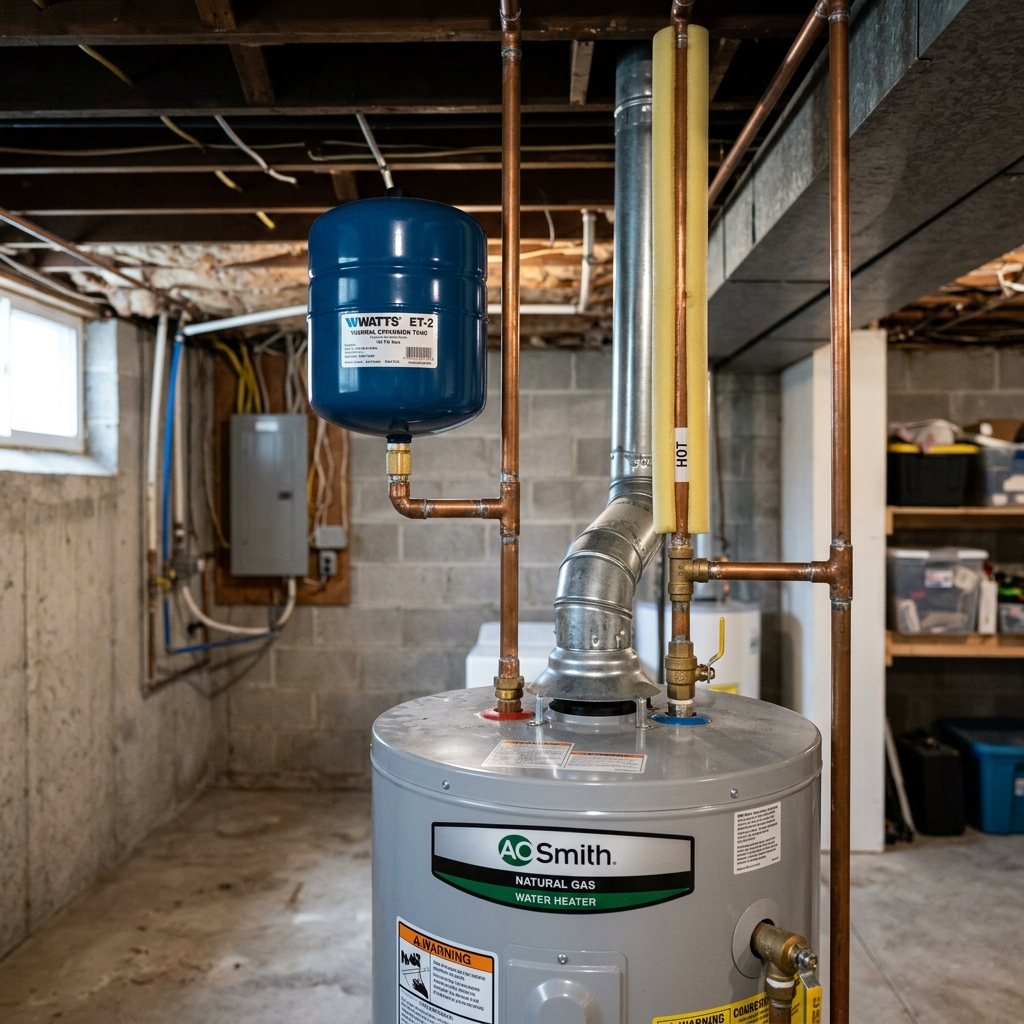
An expansion tank is a small (2-5 gallon) tank installed on the cold water line above the water heater. Inside, a rubber diaphragm separates an air chamber from the water side. When water expands, it pushes into the tank, compressing the air cushion. When hot water is used and pressure drops, the air pushes the water back into the system.
The air side must be pre-charged to match static house pressure. Too low and the tank waterlogs. Too high and water never enters. The Schrader valve on top is the check — air should come out, not water. Water from that valve means a failed diaphragm. Replacement, not a patch.
Is It Required?
IRC / UPC style language requires an expansion tank (or an approved alternative) on a water heater in a closed system. If you have a PRV, a check valve, or a backflow preventer on the main, plan on one. Your inspector and water utility have the local last word. Call the utility if you cannot identify the device.
Installation
- Mount vertically on the cold water line above the water heater (water connection down) unless the listing allows another orientation
- Pre-charge the air side to match static pressure (commonly 40–60 PSI on many houses; use the gauge reading, not a guess)
- Use a tee and a support bracket — a waterlogged tank is heavy enough to stress a single thread
- Research range, not a quote: the tank itself often lists around $40–$100; plumber-installed totals are often listed around $150–$300 extra for labor
Step-by-step tee, tape, and Schrader checks are in the longer expansion tank guide. Drain a few gallons first if you are cutting into the cold line — how to drain a hot water heater.
If the tank is already leaking at the shell, an expansion tank will not save it. That is 7 signs your water heater is about to fail.
Related Guides
- Water Heater Expansion Tank: Do You Need One?
- How to Fix a Leaking Water Heater Relief Valve
- Water Heater T&P Relief Valve
- What Size Water Heater Do You Need?
- What Temperature Should Your Water Heater Be Set To?
- 7 Signs Your Water Heater Is About to Fail
- How Hard Water Destroys Your Water Heater
- Water Heater Safety
- Water Heater Maintenance Tools
Sources
Editorial Team
Nobody should pay a plumber $300 to turn a drain valve. Our guides are built from manufacturer documentation, plumbing code references, and the documented experience of homeowners and plumbers.