What Size Water Heater Do You Need? A Sizing Guide by Household
An undersized heater runs out of hot water. An oversized one wastes energy. Here is how to calculate the right size.

May 10, 2026
Safety Disclaimer
Water heater maintenance involves working with pressurized systems, scalding hot water, and potentially hazardous electrical or gas connections. Always shut off power (electric heaters) or gas supply (gas heaters) and allow water to cool to a safe temperature before beginning any maintenance. Wear appropriate safety equipment including gloves and eye protection. If you're uncomfortable with any step, contact a licensed plumber.
Household headcount is a starting guess, not a size. A two-person house with a soaking tub and a 2.5 GPM rain shower needs more first-hour hot water than a family of four on low-flow heads. Manufacturer EnergyGuide labels rate tanks by First Hour Rating (FHR), not by the gallon stencil on the jacket.
Unique angle here: FHR and simultaneous-fixture math before you pick a gallon number. Brand SKUs live in best water heater brands of 2026. Household-fit tank vs tankless is tank vs tankless. Fuel cost after you have a size is electric vs gas.
Desk note: Tables below are manufacturer-style starting points (DOE EnergyGuide FHR, typical fixture GPM, climate temperature-rise charts). They are not a lab test from this desk and not a promise that a 50-gallon tank will cover every Saturday morning. Cost ranges elsewhere on this site are research ranges from typical listings, not quotes.
Before You Shop a Gallon Number
Do this in order. Buying the tank first is how people end up with an 80-gallon electric in a closet that cannot recover, or a tankless unit that cannot make two showers in a 40°F groundwater climate.
- Count the peak hour, not the people. Morning is usually the peak: overlapping showers, a dishwasher, and a hot-fill washer. Evening peaks look different. Write the hour down.
- Read the current rating plate. If you are replacing a working tank, copy gallons, FHR (if printed), fuel, and voltage or BTU. Same footprint and same fuel is a replacement, not a resize, unless the household changed.
- Measure incoming cold-water temperature in winter. A Taylor instant-read waterproof thermometer in a glass at the nearest cold tap, after a 30-second run, is enough. Groundwater at 40°F vs 70°F changes tankless GPM more than it changes tank gallons.
- Decide tank vs tankless vs heat pump before you shop gallons. Those are different sizing systems. Do not convert “we have a 50” into a tankless SKU by gallons.
- Then open a listing. Search pages mix RV 6-gallon units, 80-gallon hybrids, and commercial boilers on the same brand page.
Listing check (sizing): confirm the EnergyGuide / FHR (or GPM at a stated temperature rise) on the listing matches the peak-hour math — RV point-of-use tanks and 80-gallon hybrids share the same brand search.
If hardness is the reason the old tank “felt small,” size will not fix a tank half-full of scale. See how hard water destroys a water heater and signs a water heater is failing before you upsize a dying unit.
Tank Water Heater Sizing
The Quick Rule
Treat this as a first filter, not a purchase.
| Household Size | Tank Size |
|---|---|
| 1-2 people | 30-40 gallons |
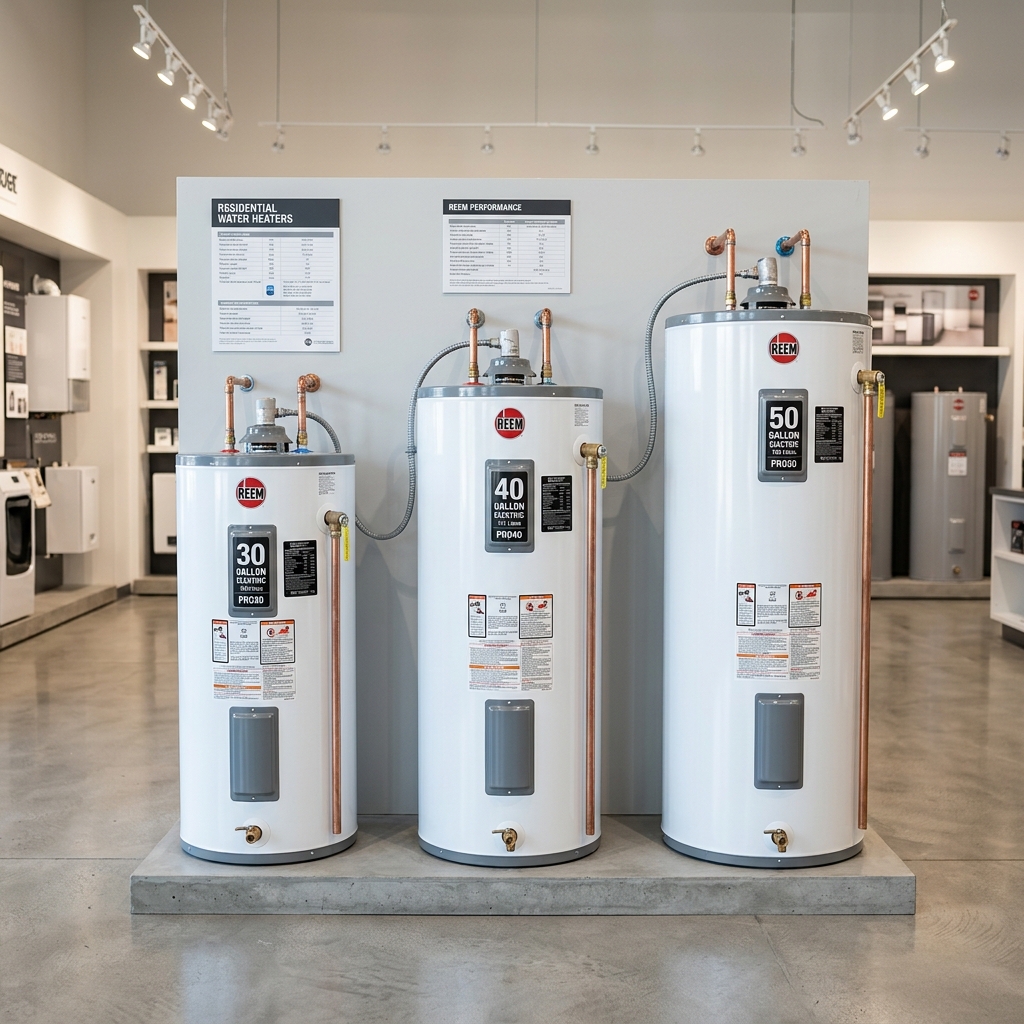
| 3-4 people | 40-50 gallons |
| 5+ people | 50-80 gallons |
A 40-gallon gas tank often outruns a 50-gallon electric on recovery. That is why FHR exists. Gas vs electric recovery and operating cost are in electric vs. gas water heaters.
The Precise Method: First Hour Rating (FHR)
The First Hour Rating is the number of gallons of hot water the heater can deliver in the first hour of use starting with a full, hot tank. DOE EnergyGuide labels use it because it folds storage and recovery into one number. Two 50-gallon tanks can have different FHRs.
To estimate the FHR you need:
- Identify the peak hour of hot water use (usually morning).
- Add the gallons used during that hour.
| Activity | Gallons |
|---|---|
| Shower | 10-15 per person |
| Shaving | 2 |
| Hand/face washing | 2 |
| Dishwasher cycle | 6 |
| Clothes washer (hot) | 7 |
A family of four with two morning showers, one dishwasher load, and hand washing lands around 40–50 gallons of FHR. That is a research-desk example using the table above, not a field measurement from this site.
Household realities the gallon stencil skips:
- Two showers at once. Two 2.0 GPM heads for 10 minutes is 40 gallons before anyone starts a dishwasher. A 40-gallon tank can still work if recovery is fast (gas) and the second shower is short. It will not work if both heads are 2.5 GPM rain fixtures.
- Soaking tub. A 60–80 gallon tub dump is a storage problem. Tankless flow can fill a tub, but only if the GPM at your climate’s temperature rise keeps up. A tank sized only to “4 people” often fails the tub test.
- Hard water and sediment. Scale steals effective volume. A 50-gallon tank with a hardened layer at the bottom behaves like a smaller tank. Flushing and hardness belong in the flush schedule calculator and the hard-water guide, not in a bigger purchase by default.
- Closed plumbing. An oversized tank in a closed system dumps more expansion volume into the pipes every heat cycle. If you have a PRV or backflow preventer, read do you need an expansion tank before you jump from 40 to 80 gallons.
Tankless Water Heater Sizing
Flow Rate (GPM)
Tankless heaters are sized by gallons per minute they can produce at a given temperature rise. Gallons of storage do not apply.
| Fixture | Flow Rate |
|---|---|
| Bathroom faucet | 0.5-1.5 GPM |
| Kitchen faucet | 1.0-1.5 GPM |
| Shower | 1.5-2.5 GPM |
| Dishwasher | 1.0-1.5 GPM |
| Clothes washer | 1.5-3.0 GPM |
Add the GPM of fixtures you expect to run at the same time. Manufacturer charts often put a typical household in the 5–7 GPM band for gas tankless, or 3–4 GPM for electric tankless — those are catalog bands, not a guarantee for every winter morning.
Temperature Rise
Incoming cold-water temperature sets the rise. Heating 40°F groundwater to 120°F is an 80°F rise. Heating 70°F groundwater to 120°F is a 50°F rise. The same unit publishes a higher GPM in Florida than in Minnesota. Read the climate chart on the listing, not the headline GPM.
Current tankless SKUs and indoor/outdoor suffixes are in best tankless water heaters. Descale interval in hard water is in best tankless flush kits.
When the Gallon Number Is the Wrong Question
Heat pump (hybrid) tanks. These are still storage tanks. Size them like a tank (FHR / gallons), then check the room: they need air volume and they cool the space. Model notes are in best heat pump water heater 2026.
Setpoint vs size. Turning the dial to 140°F to “make a small tank last longer” trades scald risk and faster scale for a few extra usable gallons. Measure and set temperature on purpose in what temperature should your water heater be set to.
A tank that is already failing. Rusty hot-only water, a leaking shell, or a heater past a typical published 8–12 year tank window is a replacement conversation, not a resize. Walk the signs first.
Skip the Listing, Call a Plumber
- New gas line, new vent, or a panel upgrade for a larger electric or a tankless unit
- A platform or closet that cannot accept the taller hybrid or the longer flue
- A well pump that cannot feed the GPM the tankless chart assumes
- Any smell of gas, a T&P that dumps steadily, or water from the steel shell
For the drain-and-flush side of living with the tank you already have, start at the how to flush hub or the drain guide.
Related Guides
- Tank vs. Tankless Water Heaters
- Electric vs. Gas Water Heaters
- Best Water Heater Brands of 2026
- How Hard Water Destroys Your Water Heater
- 7 Signs Your Water Heater Is About to Fail
- Do You Need a Water Heater Expansion Tank?
- What Temperature Should Your Water Heater Be Set To?
- Flush Schedule Calculator
- Water Heater Maintenance Tools
Sources
- U.S. Department of Energy, Water Heating, EnergyGuide / FHR context
- Manufacturer sizing charts (Rheem, A.O. Smith, Rinnai) for FHR and temperature-rise GPM
Editorial Team
Nobody should pay a plumber $300 to turn a drain valve. Our guides are built from manufacturer documentation, plumbing code references, and the documented experience of homeowners and plumbers.